Amputation is rarely the first event in a limb-threatening problem. It is often the end of a progression: reduced blood flow, an unnoticed injury, a wound that does not heal, infection, tissue loss, and delayed recognition of how serious the circulation problem has become.
Early circulation testing can interrupt that progression by identifying peripheral artery disease (PAD) or severe limb ischemia while there may still be time to protect tissue and consider treatment. The test itself does not prevent amputation. Its value is that it can reveal a blood-flow problem early enough for the patient and care team to act.
Why circulation can determine whether a wound heals
Arteries carry oxygen-rich blood to the legs and feet. A foot wound needs that oxygen, along with nutrients and immune cells, to create new tissue and control infection. When arteries are narrowed or blocked, even excellent local wound care may not be enough because the tissue is not receiving the blood supply required for repair.
In its most severe form, PAD can lead to chronic limb-threatening ischemia (CLTI). CLTI may present as pain in the foot at rest, a nonhealing ulcer, or gangrene. Current PAD guidance emphasizes timely diagnosis, coordinated wound and foot care, and revascularization when appropriate to support healing, relieve pain, minimize tissue loss, and preserve a functional limb.
Who may need an earlier circulation evaluation?
Testing is especially important when symptoms or risk factors suggest that blood flow may be limiting healing. A healthcare professional may recommend evaluation when a person has:
- A foot or toe wound that is slow to heal, recurring, or worsening
- Black, blue, or darkening tissue
- Foot pain at night or while resting
- A foot that is colder, paler, or more discolored than the other side
- Weak foot pulses or abnormal Doppler signals
- Diabetes, kidney disease, tobacco exposure, or a history of PAD
- A previous foot ulcer or amputation
Diabetes can make early recognition more difficult because neuropathy may reduce pain and sensation. A serious wound or circulation problem may therefore feel less severe than it is. Learn more about diabetes and foot risks.
What circulation testing may include
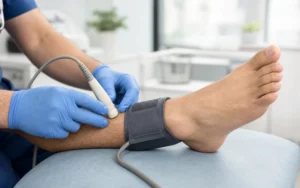
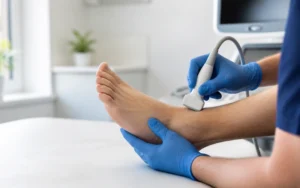
Circulation assessment is more than checking whether a pulse can be felt. It usually begins with the patient’s symptoms, the wound, skin color and temperature, pulse examination, and Doppler waveforms. Depending on the situation, testing may include:
- Ankle-brachial index (ABI): compares blood pressure at the ankle with blood pressure in the arm.
- Toe pressure or toe-brachial index: measures circulation closer to the foot and may be useful when ankle arteries are difficult to compress.
- Pulse-volume recordings and Doppler waveforms: show how blood moves through different levels of the leg.
- Duplex ultrasound: uses sound waves to locate narrowed or blocked arteries and assess blood flow.
- Transcutaneous oxygen or skin-perfusion testing: estimates whether enough oxygenated blood is reaching tissue near the wound.
- CTA, MRA, or angiography: maps arterial anatomy when more detailed planning is needed.
No single number should be interpreted in isolation. ABI can be less reliable when arteries are noncompressible, which is more common in people with diabetes or kidney disease. Toe pressures, waveforms, and local perfusion measurements may add important information. Read more about circulation evaluation and limb preservation.
How earlier testing can change the care pathway
When poor circulation is identified, the care team can better judge the urgency and coordinate the right specialties. That may include wound care, podiatry, infection treatment, diabetes management, cardiovascular risk reduction, vascular medicine, interventional radiology, or vascular surgery.
If significant ischemia is present, a vascular specialist may discuss revascularization—a catheter-based procedure, surgical bypass, or a combination intended to improve blood flow. Not every patient needs a procedure, and the safest approach depends on the wound, arterial anatomy, infection, other medical conditions, mobility, and personal goals.
Testing can also prevent a different kind of delay: repeatedly changing dressings or treating only the wound surface without recognizing that inadequate perfusion is limiting recovery. If a wound is deteriorating or failing to improve despite infection control, glucose management, pressure relief, and appropriate wound care, current diabetic-foot guidance recommends reassessing vascular status and considering specialist consultation.
Testing is one part of limb preservation
Early testing is valuable, but it is not a guarantee against amputation. Some limbs are already severely damaged when a patient reaches care, and some infections require urgent surgery. Outcomes also depend on wound severity, how long tissue has lacked blood, the feasibility of restoring circulation, and the patient’s overall health.
Limb preservation works best as a coordinated process: recognize the warning signs, assess blood flow, control infection, remove pressure from the wound, manage diabetes and cardiovascular risks, restore circulation when appropriate, and continue wound care until healing is complete.
When to seek urgent medical attention
Seek urgent care now for black or rapidly darkening tissue, spreading redness or swelling, pus or a bad odor, fever, rapidly worsening pain, or a foot that suddenly becomes cold, pale, numb, or weak. These can be signs of severe ischemia, serious infection, or an acute loss of blood flow.
Do not wait for a routine appointment when symptoms are severe or changing quickly. Contact a clinician, go to an urgent-care center or emergency department, or call 911 for sudden or life-threatening symptoms. Review more foot-wound and circulation warning signs.
The bottom line
Early circulation testing may help prevent amputation by identifying poor blood flow before tissue loss and infection progress further. It gives the care team information needed to determine whether the limb is threatened, whether additional imaging is appropriate, and whether restoring blood flow could support healing.
If a foot wound is not healing—or if rest pain, dark tissue, temperature changes, or other circulation warning signs are present—ask whether blood flow has been evaluated all the way to the foot and toes.
This article provides general education and does not diagnose a condition or replace medical care. Treatment decisions should be made with a qualified healthcare professional.