A foot ulcer that does not heal is more than a skin problem. It may be a sign that the tissue is not receiving enough blood, that infection is spreading, or that pressure and nerve damage are allowing the wound to worsen. When these problems are not recognized early, a small ulcer can progress to tissue loss and become limb-threatening.
Not every slow-healing ulcer leads to amputation. However, certain changes should prompt urgent medical assessment—especially in people with diabetes, peripheral artery disease (PAD), kidney disease, neuropathy, a history of smoking, or a previous foot ulcer or amputation.
What does “limb-threatening” mean?
A limb-threatening foot problem is one in which poor circulation, infection, tissue death, or a combination of these factors puts part of the foot or leg at risk. Severe PAD can cause chronic limb-threatening ischemia (CLTI), which may appear as persistent foot pain at rest, a nonhealing wound, or gangrene.
Foot infections can also spread into deeper soft tissue, joints, or bone. Poor blood flow makes it harder for the body to deliver oxygen, immune cells, and medications to the affected area. That is why wound care, infection treatment, pressure relief, and circulation assessment often need to happen together.
Warning sign 1: The ulcer is getting larger or deeper
A wound that expands, develops a deeper crater, exposes tendon or bone, or fails to show steady improvement needs reassessment. The surface of an ulcer can sometimes look small while damage continues underneath. A clinician may measure the wound, assess its depth, look for undermining or tunnels, and determine whether pressure, infection, or inadequate blood flow is delaying healing.
If your wound has not improved despite appropriate care, ask whether the cause has been reassessed—not just the dressing changed. Learn more about why a foot ulcer may not be healing.
Warning sign 2: Redness, warmth, swelling, drainage, or odor is increasing
Increasing redness, warmth, tenderness, swelling, pus, cloudy drainage, or a new foul odor may indicate infection. Red streaks moving up the foot or leg, rapidly spreading swelling, or drainage under pressure are especially concerning. Infection can progress quickly and may require antibiotics, drainage, removal of infected tissue, or hospital care.
Fever, chills, confusion, unusual sleepiness, fast breathing, or feeling suddenly very unwell may signal a severe infection. These symptoms require urgent evaluation. People with diabetes may still have a serious foot infection without a high fever, so the absence of fever should not be used as reassurance.
Warning sign 3: Skin is turning black, blue, gray, or dusky
Darkening skin can indicate severely reduced blood flow, tissue death, bleeding beneath the skin, or advanced infection. Black tissue may represent gangrene. Blue, gray, purple, or mottled color changes can also be warning signs, particularly when the foot feels colder than the other side.
Do not cut away dark tissue, soak the foot, apply chemicals, or wait for it to fall off. The wound and circulation need prompt professional assessment.
Warning sign 4: The foot is unusually cold, pale, numb, or weak
A sudden cold, pale, numb, painful, or weak foot can mean an acute loss of arterial blood flow. This is a medical emergency. Call 911 or go to an emergency department immediately, especially if the change began suddenly or is getting worse.
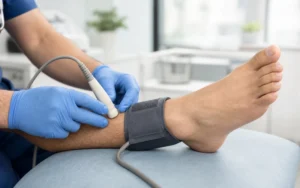
More gradual temperature or color differences may still suggest PAD. A clinician may check pulses and Doppler waveforms and order tests such as an ankle-brachial index, toe pressure, or vascular ultrasound. Because ankle measurements can be misleading when arteries are stiff or calcified, toe pressures and other perfusion tests may be helpful in people with diabetes or kidney disease.
Warning sign 5: Pain is worsening—or there is no pain at all
Increasing pain, pain in the foot while resting, or pain that wakes you at night can be a sign of severe ischemia or infection. Some people notice temporary relief when they lower the foot below the level of the heart. New, severe, or rapidly worsening pain needs urgent evaluation.
But pain is not a reliable measure of severity. Neuropathy can reduce sensation, allowing a deep or infected ulcer to worsen without causing much discomfort. A painless wound can still be dangerous. Inspect the foot visually rather than relying only on how it feels.
Warning sign 6: Bone, tendon, or deep tissue is visible
An ulcer that exposes deep structures has a higher risk of serious infection, including infection of the bone. Persistent drainage, a “sausage-shaped” swollen toe, or a wound that reaches bone may also raise concern for osteomyelitis. Diagnosis may require examination, laboratory testing, X-rays, MRI, or a bone sample; appearance alone cannot confirm it.
Warning sign 7: The wound is not improving despite treatment
A wound may stall when one or more essential parts of care are missing. Common barriers include continued pressure on the ulcer, uncontrolled infection, inadequate blood flow, high glucose levels, swelling, smoking, poor nutrition, or an incorrect diagnosis.
When an ulcer is not healing as expected, the care plan should be reviewed. That may include checking whether pressure is being effectively offloaded, obtaining appropriate cultures or imaging when infection is suspected, and evaluating circulation all the way to the foot and toes. Read how early circulation testing may support limb preservation.
When to seek emergency care
Call 911 or go to an emergency department now if the foot suddenly becomes cold, pale, blue, numb, weak, or severely painful; if redness or swelling is spreading quickly; if there is extensive black tissue; or if the person has confusion, difficulty breathing, fainting, or other signs of severe illness.
Seek same-day medical advice for new drainage or odor, increasing redness or warmth, worsening pain, a deeper or larger ulcer, new dark discoloration, visible bone or tendon, or an ulcer that is failing to improve. If you are unsure how urgent the change is, err on the side of being evaluated promptly.
What a limb-preservation evaluation may include
A complete evaluation looks beyond the wound surface. Depending on the findings, the care team may assess:
- Wound size, depth, drainage, tissue color, and pressure points
- Signs of soft-tissue or bone infection
- Foot pulses, Doppler signals, toe pressures, and local tissue perfusion
- Neuropathy and loss of protective sensation
- Blood glucose control, kidney function, nutrition, and medications
- Footwear, offloading, mobility, and the ability to perform wound care
Treatment may involve wound care, pressure relief, antibiotics when infection is present, glucose and cardiovascular risk management, and consultation with podiatry, wound specialists, infectious-disease clinicians, or vascular specialists. If severe ischemia is found, revascularization may be considered to improve blood flow and support healing.
The bottom line
A nonhealing foot ulcer becomes more dangerous when it is enlarging, deepening, infected, changing color, associated with rest pain, or accompanied by signs of poor blood flow. Lack of pain does not mean the wound is safe. Early recognition and coordinated treatment can create more options for healing and limb preservation.
If a foot ulcer is worsening or not improving, ask for a complete evaluation of infection, pressure, nerve damage, and circulation. Do not wait for a routine appointment when warning signs are severe or changing quickly.
This article provides general education and does not diagnose a condition or replace medical care. Treatment decisions should be made with a qualified healthcare professional.